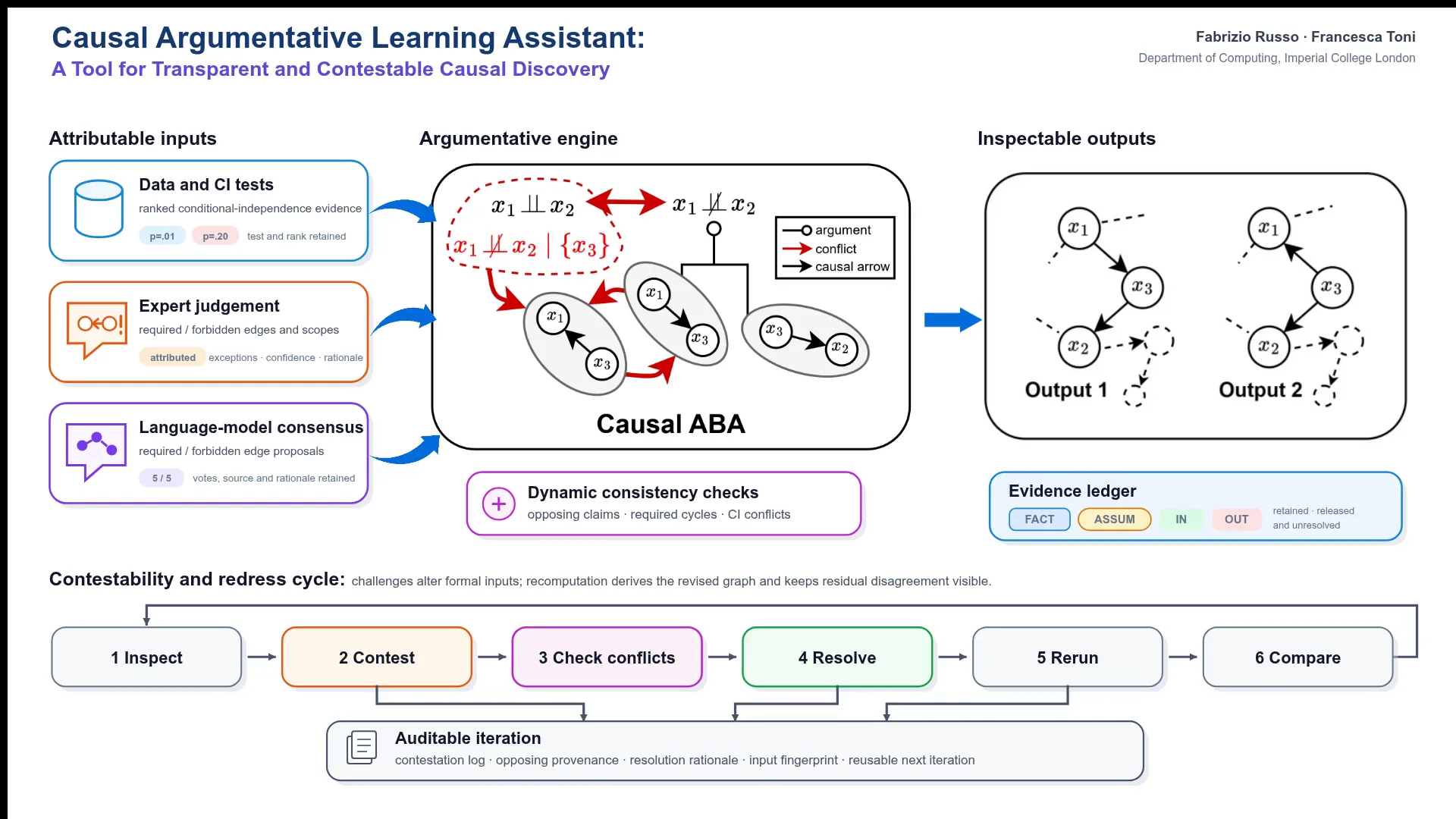
Evidence can conflict
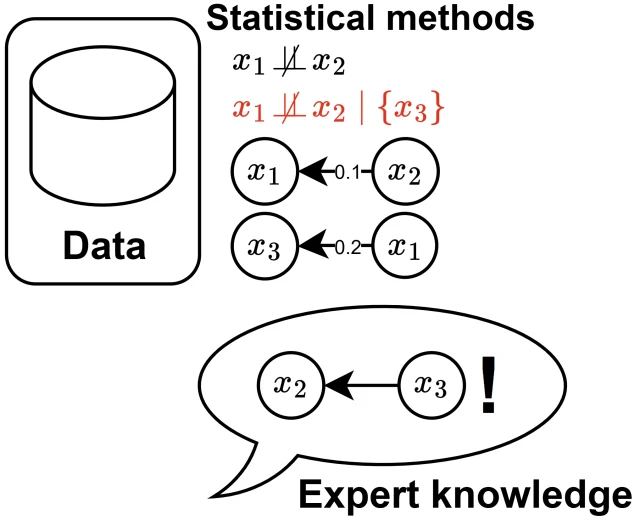
Statistical tests, causal assumptions and expert knowledge may support incompatible conclusions.
Causal AI, open to challenge
Transparent, explainable and contestable causal discovery.
European Research Council Proof of Concept Grantbuilding upon the Advanced Grant ADIX

The problem
Causal discovery helps build the assumptions needed for causal analysis, uncover scientific knowledge and support better decisions when randomised controlled trials are impossible or too costly. Because those assumptions shape what follows, they should remain open to scrutiny.
Statistical tests, causal assumptions and expert knowledge may support incompatible conclusions.
A domain expert should be able to inspect, challenge and qualify a causal claim—not simply override a graph.
CArLA keeps the origin, confidence and consequences of each judgement visible through revision.
The foundational workflow
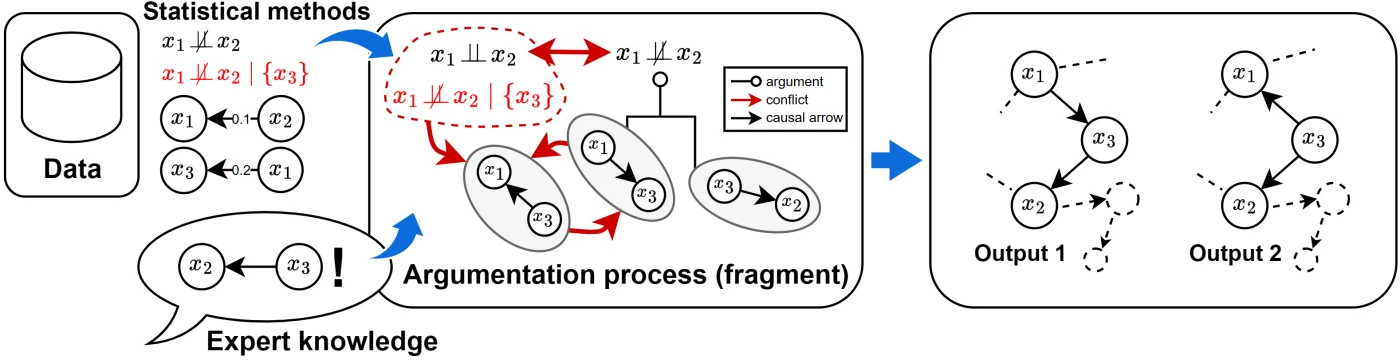
First introduced in Argumentative Causal Discovery, the method represents causal evidence as arguments whose support and conflicts can be inspected.
Combine statistical evidence from data with causal knowledge supplied by experts. Neither source is assumed to be infallible.
Translate evidence into arguments and preserve the conflicts between incompatible causal claims.
Use argumentative reasoning to identify the causal structures supported by the available evidence—without hiding uncertainty.
What CArLA is building
CArLA aims to move from a one-shot graph towards an interactive process in which evidence, explanations and revisions remain available for review.
Expose the evidence and assumptions behind each supported causal structure.
Support why, why-not and what-if questions about causal claims and alternatives.
Let experts challenge inputs and make the consequences of revisions visible.
Combine exact reasoning with efficient solvers and learned approximations.
Planned application domains: healthcare and finance provide high-stakes settings in which transparent, expert-led revision matters. The public demo currently uses the Asia research benchmark.
Research
The work moves from the foundational method to finer-grained semantics, scalable approximation, language-model knowledge, and methods for contestability and redress.
Combines statistical evidence and expert knowledge through assumption-based argumentation, making causal conflicts explicit and returning supported alternative structures.
Assigns dialectical strength to assumptions, enabling more nuanced comparisons than binary acceptance alone.
Uses heterogeneous graph neural networks to approximate credulous acceptance and reconstruct stable extensions for large ABA frameworks.
Uses language models as imperfect experts that propose causal constraints, then evaluates those constraints alongside statistical evidence through Causal ABA.
Recasts the release of inconsistent causal constraints as a cost-aware repair problem using optimal minimal correction sets.
People
CArLA brings together causal discovery, computational argumentation, explainable AI and practical experience in high-stakes modelling.

Principal Investigator and strategic lead
Argumentation, interactive explainability, contestability and project leadership.

Technical lead
Causal discovery, statistical learning, explainable AI, contestability and software engineering.

Argumentation and explainability
Computational argumentation theory, scalability and explainable AI.
Student contributors and supervised research
Dhruv Himatsingka · Zihao Li · Yeva Hunanyan · Preesha Gehlot
Meet the people behind the work